Serial No 07 (12-02-2001 to 18-02-2001) ANSWERS BELOW
| This Week's Seven P's |
Feel free to e-mail us:
E-Mail: Sanat Sahu/M laguri
Prob No. 1)
A solid right cone of height h and made
of material of density d2 floats on a liquid of density d3
contained in a large container with its apex down. Height of the cone lying
below the surface of the liquid is (2/3)1/3 h. Another liquid of
density d1 is poured into the container such that the cone submerges
completely. Height of the cone lying below the surface of the former liquid
is now (1/2)1/3 h. Show that
d1: d2 : d3 :: 1 : 2 : 3
Assume above liquids to be immiscible.
Prob No. 2)
A rod having uniform area of cross-section
and its mass uniformly distributed is held vertically above large pool of liquid
of such that its bottom most point just touches the liquid surface. When released
the entire rod just dips into the liquid before bouncing back upwards.
(i) Find ratio of densities of the rod and the liquid.
(ii) If the length of the rod and acceleration due to gravity are given as L and g, find out how long the since the time of release the entire rod takes the dip.
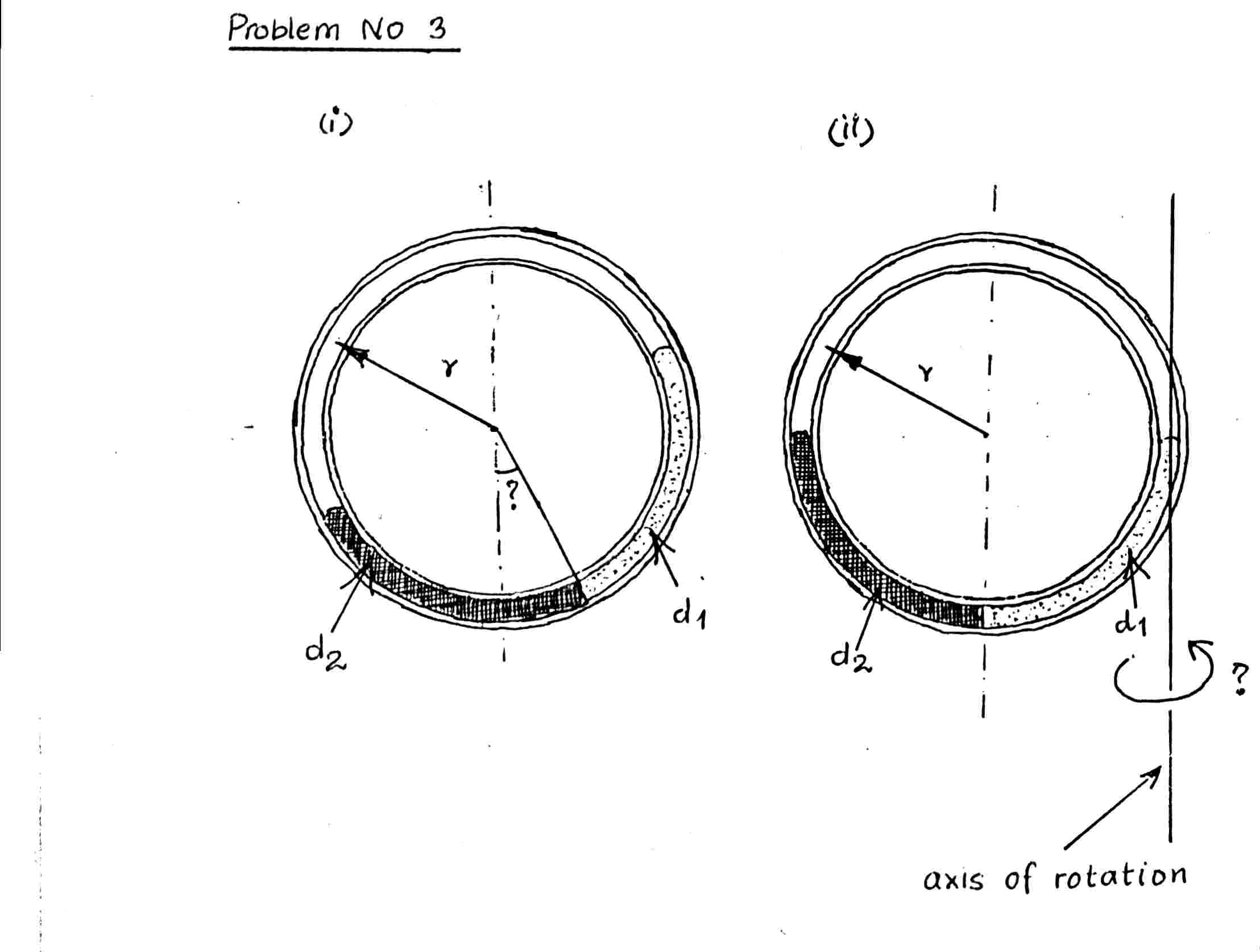
Prob No. 3)
(Refer diagram) A tube of small cross-section
is bent into circle. Equal volumes of two immiscible liquids of densities d1
and d2 (d1>d2) occupy half the tube.
(i) Find out angle a point of common surface will make with the vertical.
(ii) If the radius of the circle and acceleration due to gravity are given as r and g, find out angular speed by which it must be rotated about a vertical axis which is tangential to the circle so that the common surface lies just below the centre (the axis is so chosen that the lighter liquid is nearer than the heavier liquid from it).
Prob
No. 4)
The tube-liquids system described in Prob No 3 is kept in car moving on a circular
path of radius R. The system is held in the vertical plane which moves with
the car and is always perpendicular to the direction of the motion. The lighter
liquid is towards the centre of the circular path. For what speed of the car
the common surface will just be below the centre of the system? Assume radius
of the system to be negligible as compared to the radius of the circular path
and take the gravitational acceleration as g.
Prob No. 5)
One end of a uniform rod of length L and
density d1 is hinged at the bottom of a large container and the rod
can have free movement in a vertical plane. Find the maximum height the container
is required to be filled upto with the liquid of density d2 such
that the rod stays vertical and is stable.
Prob No. 6)
A mark has been put on a spring (weight
w, spring constant k) at the middle of the length when it is in relaxed state.
It is suspended vertically from one end and partially immersed in a liquid (density
d) such that the mark just lies on the liquid surface. The difference in elongations
suffered by upper and lower halves is Δe. What is the density of the material
the spring is made of?
Prob No. 7)
A top open cylindrical thank of height
H (axis vertical) having two identical holes on its vertical wall is filled
upto the top with some liquid. After a certain time the level falls to a height
where one of the holes is located. If same amount of time is further needed
to completely empty the tank, find out the heights from the bottom the holes
are located at.
Answers
| Prob 1 | No Answer |
| Prob 2 | (i) 1: 2 (ii) π /√2 x √(l/g) |
| Prob 3 | (i) tan-1((d2 - d1)/(d2 +d1)) (ii) √(2g/r x (d2 - d1) / (3d2 - d1)) |
| Prob 4 |
√(gR x (d2 - d1)/(d2 + 1)) |
| Prob 5 | √(d1/ d2 ) x L |
| Prob 6 | wd / (2w - 8k Δe) |
| Prob 7 | 0.132 H and very close to the bottom |